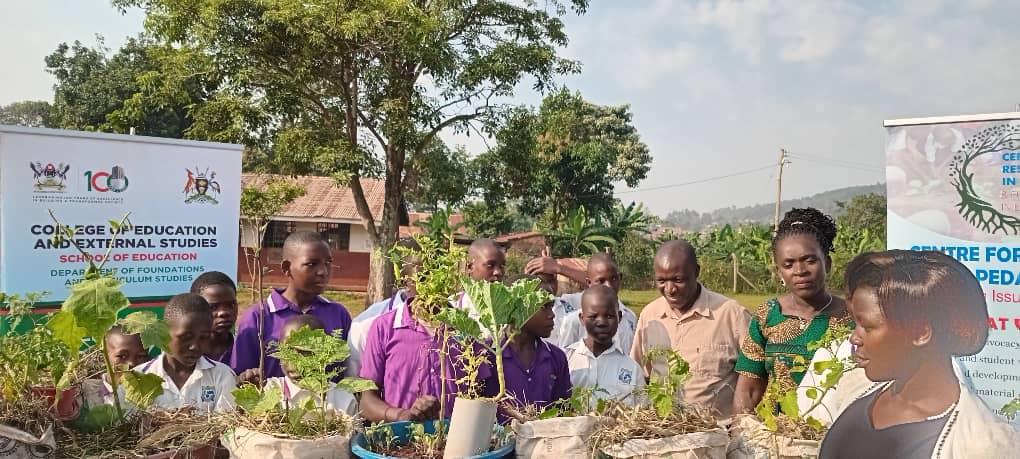
Entrepreneurship Education for Students in Education Institutions.
Over 20.1 million of Uganda’s population of 45.9 million, are in the age bracket of 15 – 24 years of (UNPC, 2024) hence are still in post primary institutions and less productive to themselves, their families and the country. After graduation, they are faced by wide spread unemployment estimated at 83% (AFDB, 2016). Consequently, the country is unable to produce sufficient number of jobs for graduates entering the job market every year. Under the circumstances, entrepreneurship skills development for those still in education institutions is an answer to this challenge.
Our intervention is unique because of its action-orientated training, where participants form teams of between 9 and 12 individuals. The formed team identifies and evaluates new business opportunities, registers a business, gets a Tax Identification Number (TIN), acquires equipment and raw materials, deals with suppliers, and enters the market to offer their product or service to real customers. Further, each team acquires seed capital to start and run a micro-business for the 36 weeks of training. At the end of the training, teams declare they keep the profit they make in their business and properly make accountability for the losses incurred.
Expected Project outcomes:
On successful completion of the training, a participant moves out with:
- Increased intention to undertake entrepreneurship activities
- Practical knowledge on how to start and manage a new business
- Increased awareness of entrepreneurship opportunities and challenges.
- Increased employability skills
- Knowledge and skills needed to create one’s own businesses
- Real-life business knowledge, skills and experiences, such as marketing, writing a business plan or registering your business
- A certificate of merit on successful completion of the training
- Entrepreneurial skills ready for use to succeed in self-employment and employment life
Course Content.
The training covers a broad spectrum of the entrepreneurship process ranging from; Identifying business opportunities, Planning and Implementing plans, Marketing, Leadership, Strategic Management, Finding Starting Capital, Managing Finances, Bookkeeping, Overcoming Barriers to entrepreneurship, Persuasion and Negotiation Skills, writing a business plan and registering a business, among others.
CAPACITY BUILDING OF PHD IN EDUCATION BY RESEARCH CANDIDATES IN UGANDA RESEARCH METHODOLOGY
The effectiveness of doctoral programs in many African countries, including Uganda, has been compromised by systemic gaps in research training, particularly in the areas of advanced research methods. This is especially evident in PhD in Education by Research programs, where candidates often struggle to develop comprehensive, diverse research methodologies suited to the complexities of modern educational inquiries. These candidates often begin writing their research proposals based on the foundational skills they acquired during their Master’s coursework, which do not adequately prepare them for the rigor and complexity of PhD-level research.
Many PhD research supervisors in the country, who typically obtained their doctoral degrees through research with a focus on one particular research paradigm, tend to advise their students to adopt a similar research approach regardless of the research questions or the needs of the study. Consequently, candidates are restricted to working within a single research paradigm, limiting their ability to explore and apply multiple methodologies that are necessary for addressing diverse research problems. This lack of methodological versatility significantly hinders the quality of their dissertations and the overall outcomes of their research.
Moreover, when these candidates graduate, they face challenges in moderating vivas or marking theses that utilize research paradigms outside their own comfort zones or expertise. To address this gap, the Centre for Research in Pedagogy and Emerging Issues in Education offers a comprehensive, hands-on training in advanced qualitative, quantitative, and mixed methods, equipping you with the skills you need to conduct robust and diverse research.